

Table of Contents


Follow-up care: Some plans cover adjustments and maintenance services.





No, not all Medicare Advantage plans include hearing aid coverage. While many do offer some level of hearing benefits, coverage varies significantly between plans, even from the same insurance company.
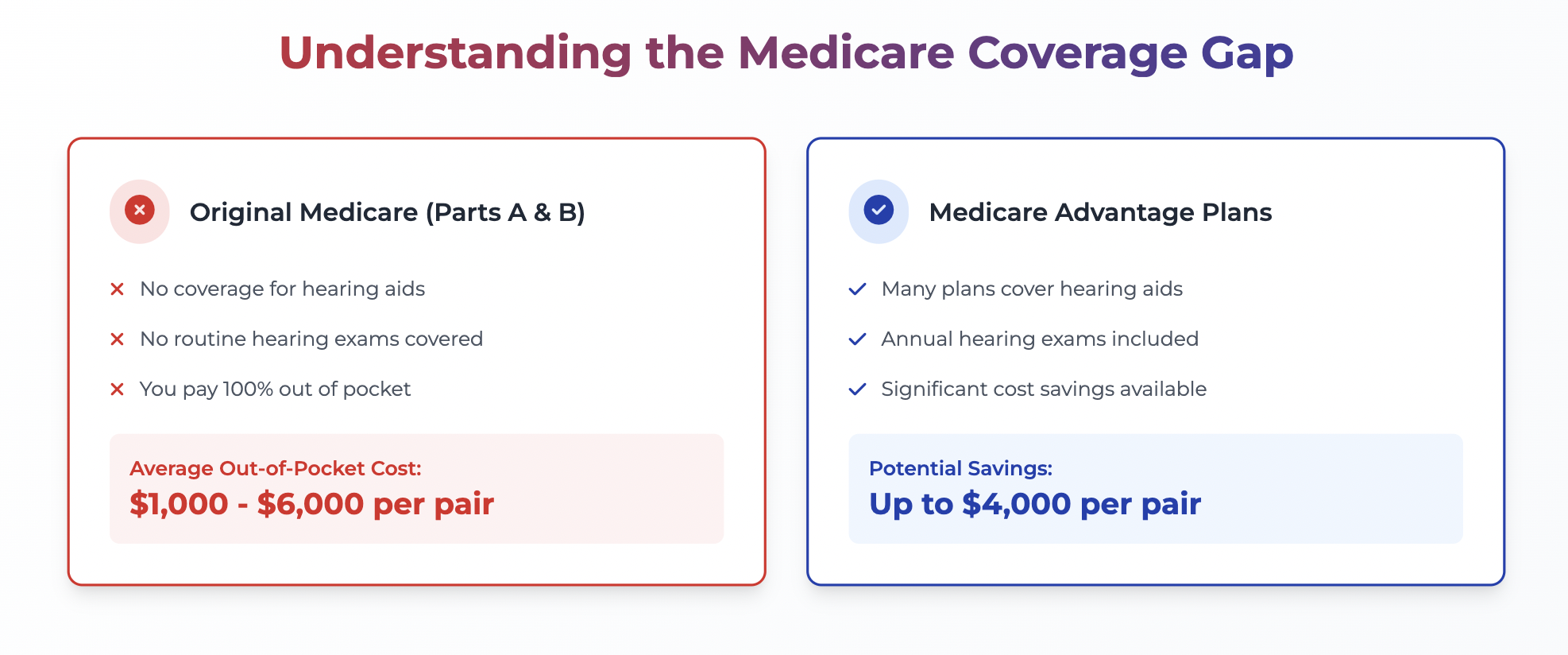
When researching plans, you’ll find that coverage rates have increased in recent years, with the Kaiser Family Foundation reporting that about 97% of Medicare Advantage plans now offer some form of hearing benefits. However, the depth of that coverage varies dramatically.
For example, some plans might only cover hearing exams but not the devices themselves, while others provide comprehensive coverage including exams, fittings, and the actual hearing aids. This is why it’s crucial to read the specific details of each plan’s Evidence of Coverage document rather than just checking if hearing benefits are included.
Call 1-800-924-4727 or visit our website at seniorbenefitclient.com to get started
Your out-of-pocket costs will depend on your specific plan’s coverage. Some plans offer an allowance (often ranging from $500 to $2,000 per ear), while others use a copayment structure based on the technology level (typically ranging from $399 to $999+ per hearing aid).
These variations in cost structure can have a significant impact on your finances. For instance, a plan with a $500 allowance per ear might seem generous until you realize that premium hearing aids can cost up to $3,000 per ear, leaving you with substantial out-of-pocket expenses.
Alternatively, a plan with a fixed copayment structure might be more beneficial for those needing higher-end technology. For example, paying a $999 copay for a premium hearing aid that retails for $3,000 represents significant savings. Our advisors can help you calculate which payment structure would be most advantageous based on your specific hearing needs.
Call 1-800-924-4727 to get started.
Most Medicare Advantage plans require you to use in-network providers for hearing services and hearing aids. Many work with specific hearing benefit administrators like TruHearing or NationsHearing, which may further limit your provider and brand options.
This network restriction is one of the most overlooked aspects of Medicare Advantage hearing benefits. Even if you’ve been seeing the same audiologist for years and have established a trusted relationship, you may be forced to switch to an in-network provider to access your hearing benefits.
Additionally, these hearing networks often have agreements with specific manufacturers, which means your options may be limited to certain brands or models. For instance, if you’ve researched and determined that Phonak hearing aids would best address your specific type of hearing loss, but your plan only covers Signia devices through TruHearing, you’ll face a difficult choice between using your benefits or paying out-of-pocket for your preferred brand.
Call 1-800-924-4727 or visit our website at seniorbenefitclient.com to get started
This varies by plan, but many Medicare Advantage plans cover new hearing aids every 1-3 years. Check your plan’s Evidence of Coverage document for specific frequency limitations.
The frequency limitation is particularly important to consider when evaluating plans. Hearing aid technology improves rapidly, and your hearing needs may change over time. A plan that offers replacement every year provides significantly more flexibility than one that only covers replacements every three years.
Moreover, these limitations typically apply even if your hearing aids are lost, damaged, or no longer adequate for your hearing loss. For example, if your plan has a three-year replacement policy and your hearing aids are lost after only one year, you may need to pay full price for replacements unless your plan has specific provisions for lost or damaged devices. Our advisors can help you understand these nuances and find plans with more favorable replacement terms.
If cost remains a barrier, look into charitable foundations, local Lions Clubs, state assistance programs, or over-the-counter hearing aid options, which are generally more affordable than traditional prescription hearing aids.
Many seniors are unaware of the variety of assistance programs available. For example, the Starkey Hearing Foundation’s Hear Now program provides hearing aids to those who meet their financial criteria. Similarly, the Lions Club International has hearing aid recycling programs in many communities.
State-specific programs may also provide assistance. For instance, some states offer hearing aid loan banks or financial assistance programs for seniors who meet certain income requirements. Additionally, the recent introduction of over-the-counter hearing aids has created more affordable options for those with mild to moderate hearing loss, with prices typically ranging from $200 to $1,000 per pair—significantly less than traditional prescription hearing aids.
Yes, during the Annual Enrollment Period (October 15 – December 7), you can switch from Original Medicare to a Medicare Advantage plan with hearing benefits. Just be aware that switching plans affects all your healthcare coverage, not just hearing benefits.
This decision requires careful consideration of your overall healthcare needs. While gaining hearing aid coverage is valuable, you’ll also be adopting the Medicare Advantage plan’s network restrictions, copayments, and other rules for all your healthcare services.
Before making this switch, it’s essential to verify that your preferred doctors and specialists are in-network with the new plan. You should also compare out-of-pocket maximums, hospital coverage, and prescription drug benefits to ensure you’re not compromising on other important aspects of your healthcare. Our Medicare specialists can help you perform a comprehensive comparison that takes all these factors into account.
Are you finding Medicare’s hearing aid coverage options confusing? You’re not alone. Thousands of seniors struggle to navigate these complex choices each year.
Let our experienced advisors at Senior Benefit Services guide you through your options. We’ll analyze your specific hearing needs, budget constraints, and preferred providers to find the Medicare Advantage plan that offers the best hearing aid coverage for your situation.
Call us today at 1-800-924-4727 for a free, no-obligation consultation. Your journey to better hearing starts with a simple conversation.
Hours :

Hours :
Hours :

Hours :
Hours :
Hours :